
Vision 2030
Sigma Aldrich builds documented chemistry supply for the next decade.
The company vision is straightforward: make chemical selection more transparent, make documentation easier to retrieve, and help buyers connect bench chemistry with plant reliability. For industrial teams, that means fewer blind substitutions and stronger communication around hazard, purity, package, and shipment expectations.
Targets Table
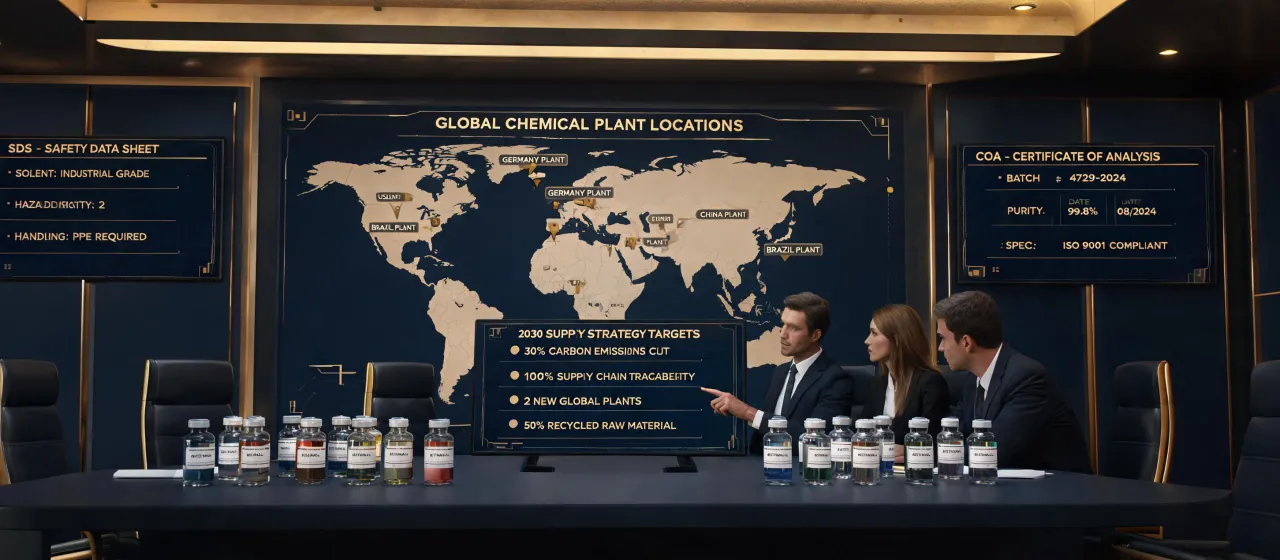
2030 operating targets
| Target | 2026 baseline | 2030 goal |
|---|---|---|
| SDS retrieval coverage | High-volume families prioritized | Digital access for every stocked chemical family |
| Lot traceability | Document basket in active rollout | CoA linkage visible during inquiry |
| Packaging fit | Manual review for hazardous and bulk materials | Recommendation rules embedded in finder workflow |
| Responsible disposal guidance | Provided on request | Included in regulated inquiry responses |
| Substitution review | Handled by technical support | Structured grade comparison for core solvents and reagents |
| Regional resilience | Global sourcing model | Dual-source planning for critical categories |
| Customer response | Case-based triage | Priority routing by hazard and production impact |
| Data integrity | Separate SDS, CoA, and catalog records | Unified document basket for buyer teams |
The targets emphasize practical control rather than broad corporate language. Chemical buyers often struggle when product identity, certificate availability, and delivery constraints live in separate conversations. Sigma Aldrich is positioning its process around connected documentation, technical review, and procurement visibility. That approach helps teams explain a purchase internally, compare alternatives responsibly, and avoid late-stage surprises when a material reaches quality release.
Growth Platforms
Three platforms guide investment.
Circular handling
Support for solvent recovery questions, waste minimization, and better container fit in production environments.
Advanced documentation
SDS, CoA, hazard statements, and certificate context organized for technical purchasing teams.
Specialty supply
Grade selection and custom synthesis routes for sensitive or high-consequence chemical applications.
These platforms reflect the way chemical purchasing has changed. Buyers still need availability and price, but they also need proof. The strongest supplier response connects a technical specification with an operational answer: whether the product can be stored safely, whether the lot documentation satisfies quality teams, and whether the same grade can be repeated after a successful trial. Sigma Aldrich frames its portfolio around those durable questions.
Innovation Pipeline
Five-stage review from need to release.
The pipeline keeps decisions traceable. A technical buyer can enter with a simple chemical name or a detailed specification. From there, the review checks product identity, available documentation, handling sensitivity, and supply pathway. When the inquiry advances, the same details inform sample preparation, commercial offer, and future replenishment. This reduces the chance that a trial material and production material diverge in ways that create avoidable validation work.
Strategy Report
Request the supply strategy brief.
Use the form to ask for documentation workflows, catalog coverage, or a discussion with a technical chemical supply specialist.